"I have measured out my life with coffee spoons"
~ T.S. Eliot
"The Love Song of J. Alfred Prufrock"

Sunday, March 18, 2012

UNC-Chapel Hill

It's March 18. This afternoon at 5:15, my Alma Mater UNC meets Creighton in the NCAA March Madness basketball championship tournament. Even President Obama has picked Carolina to win the whole thing, knock on wood. I've seen them win it all so many times. I go back to the prime of Coach Dean Smith, when it seems we always made the Final Four, winning the title quite often.

I spent so many years of my life in Chapel Hill for one reason or another that it will always feel like home to me. Just going there was such a treat when I was in high school. We would go down to visit Morehead Planetarium and Science Center, one of oldest and largest institutions of its kind and one that was used to train Gemini and Apollo astronauts in celestial navigation.

Morehead Planetarium and Science Center


Chapel Hill was always the center of a liberal oasis in a Red State Right Wing desert. Jesse Helms, in the days before he was in the Senate, used to spew an editorial on Channel 5 in Raleigh, and he often railed about the Communists down the road in Chapel Hill. The state zoo, which is quite nice, is in Asheboro, but Helms once said we didn't need a zoo. Just put a fence around Chapel Hill, he said. Then we'd have a zoo. Chapel Hill elected Howard Lee, an African American, mayor in the early seventies. The town and the campus were always ahead of the times. It was refreshing just to be there.

Here's the University of North Carolina at Chapel Hill's Wilson Library. When I first went to Chapel Hill, this was the most important library on campus. There was a newer Undergraduate library, but Wilson was the Graduate Library, the place for serious research. When I first visited the Harvard campus and saw Widener library, I thought of Wilson. As a "public ivy," Carolina made its research libraries comparable to those in the Ivy League. (Before the cutters and levelers came through in the 80s and 90s and now again, creating mediocrity wherever they can. The library has had books stay in the shipping boxes, uncatalogued and unavailable to students because of personnel cuts, but no one with power cared.)

Wilson Library, UNC-Chapel Hill

I worked at Wilson while my then husband was in medical school, in the periodicals division and got more education than I had in any classroom. I've had many lunches with my friends on that stone wall in front, happily running back up those steps into the lobby of a library that LOOKED like a library, like a miniature Library of Congress, complete with dome. Later, when I was in grad school, the linguistics department was in the first building to the right of Wilson, Dey Hall, sitting at a 90 degree angle, making a corner of the campus quad. Before I finished my Ph.D., a new graduate library was built, a modern building, no longer in the center of campus, and Wilson began to be used for other purposes. But it will always be what a library is supposed to be to me.

The Bell Tower is another campus landmark. The Patterson-Morehead Bell Tower has been ringing in each hour of the day since 1931. The landscaping around the Tower is breathtaking and was designed by William C. Coker of the Botany department. There is a Bell Tower parking lot that I was lucky enough to find space in back in the Seventies when I worked across the street at the library. These days you park in a satellite lot and take a bus in to the central campus or get your daily exercise hiking in. Chapel Hill's village character is lost, but I still love it anyway. The Bell Tower stands next to the football stadium between the academic campus and the health sciences campus. And there's a spot on the quad where you can stand from which the top of the tower looks just like a dunce cap on the dome of the library. Legend has it that this came out of a rivalry between the men who founded the buildings.


The Bell Tower


Most post cards of Carolina seem to show the Old Well, the symbol of the campus, which is always surrounded by the most beautiful landscaping. The Old Well stand near Old East, the oldest building on campus. For many years the well was the source of water to the first dorms, Old East and Old West. Its shelter and landscaping were added in stages and now there is a drinking fountain many believe brings good luck. And there's a huge, beautiful arboretum on campus. Carolina's picturesque quadrangle makes it one of the most beautiful campuses in the country, full of trees, grass, flowers, and stone walls and brick walkways, and little mini-quads filled with flowers that sit behind the first row of buildings facing the main quadrangle. Across Franklin Street from campus is the small village-like downtown, full of bars, restaurants, and shops. There used to be the best bookstore ever downtown, the Intimate Bookshop, with wood floors that creaked loudly and books stacked and crammed everywhere, but it moved to the mall a long time ago after a fire, and I think it eventually closed altogether.


The Old Well

at the Arboretum


one of the mini-quads off the main quad 

Many restaurants come and go, but some become traditions. Off Franklin Street, down Amber Alley, way below downtown, there was an artisan's shop for handmade jewelry next to the classic Rathskellar, which has been a landmark for generations. The restaurant had many rooms, one of which was the cave room, pictured here in days gone by. See the German Shepherd? The Rat, a favorite with alumni, was scheduled to reopen last year, after being closed for several years. I've even taken my mother there. I love it. There's Crooks Corner, gourmet Southern restaurant, specialty: shrimp and grits, which was raved about by the late Craig Claiborne, food critic for the NY Times.  Claiborne also enjoyed a little place on Rosemary Street, Mama Dips Country Kitchen, for the best breakfast in town. Dean Smith said that Chapel Hill couldn't be the Southern Part of Heaven without Mama Dip, who began her restaurant in 1976. My favorite bar was always He's Not Here. They had Pac Man and no waiters.
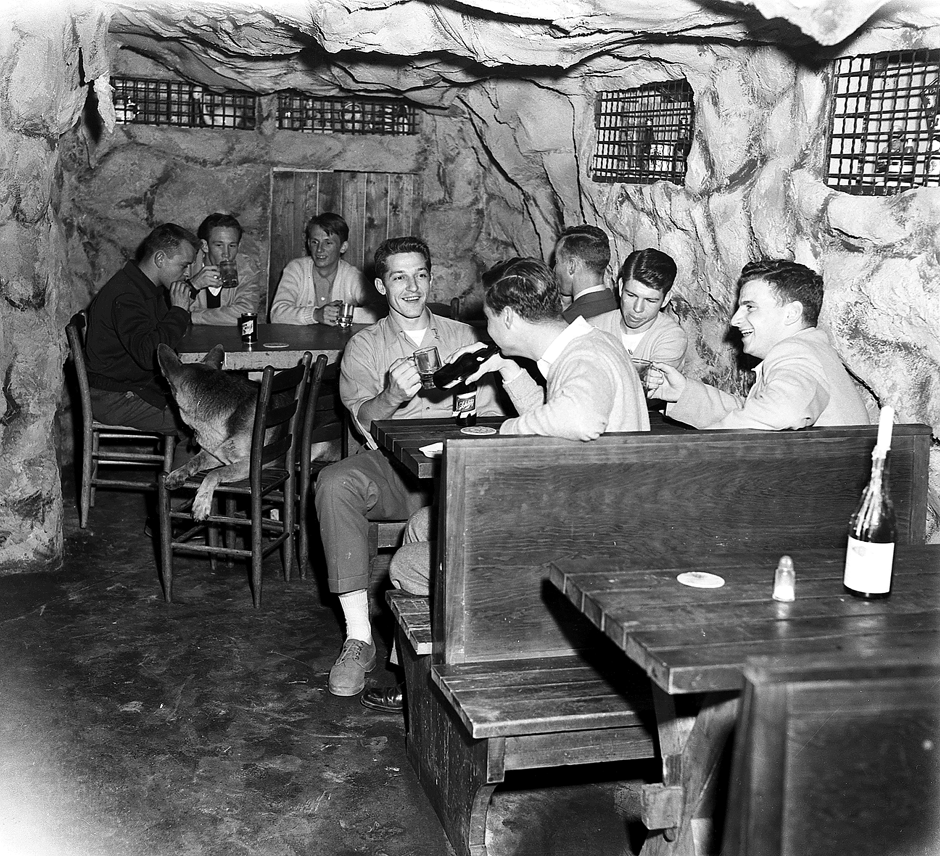

The Rathskellar's Cave Room back in the day


Mama Dip's

He's Not Here

The Quad as seen from Wilson Library

Chapel Hill. I worked there, I played there, I studied there. I loved there, I lost love there. I got my heart broken in Chapel Hill, broken into little pieces. But I learned so much that I realized I didn't know much compared to what there is to know. I learned that one lifetime is not enough to learn much at all. I learned to love learning. I learned to teach. I developed habits of reading and learning and reasoning that I keep to even this day over forty years after I first moved there. You can buy watches and clocks that sing, "I'm a Tarheel born and a Tarheel bred, And when I die I'll be a Tarheel dead." That's me.

Go Heels!


The little village of Chapel Hill.

Thursday, March 15, 2012

Brown's Thoughts of Death


Sterling A. Brown


Thoughts of Death


Thoughts of death
Crowd over my happiness
Like dark clouds
Over the silver sickle of the moon

      Death comes to some
      Like a grizzled gangster
      Clubbing in the night;
      To some
      Like an obstinate captain
      Steadily besieging barriers;
      To some like a brown adder
      Lurking in violet-speckled underbrush;
      To some
      Like a gentle nurse
      Taking their toys and stroking their hot brows.

      Death will come to you, I think,
      Like an old shrewd gardener
      Culling his rarest blossom . . . .


Sterling A. Brown, The Collected Poems of Sterling A. Brown, ed. Michael S. Harper, HarperCollins Publishers, 1980.

Wednesday, March 7, 2012

Anniversary of Bloody Sunday, 1965

On this day in 1965, more than 600 people walked toward the Edmund Pettus Bridge in Selma, Alabama, planning to march across to Montgomery on the other side. Before they reached the bridge they were met by local police and state troopers. 


When the 600 civil rights marchers refused to turn back, they were tear-gassed. People were brutally beaten by officers with billy clubs. Fifty people required hospitalization. They didn't make it across. This day has come to called Bloody Sunday. 


Soon, however, a court ruled that they were entitled to federal protection. On March 21, the march from Selma to Montgomery was successfully completed, five months before the Voting Rights Act would pass. 


These brave souls helped change America 47 years ago today.


Peaceful protesters beaten, manhandled.


What a terrible intimidating sight.

Friday, March 2, 2012

Paradise Lost

Those of us who fought the battles of Women's Liberation forty years ago have gotten older. We who fought for the Equal Rights Amendment, which we never got, are reaching retirement age. But that does not mean we can rest. The freedom of our daughters and granddaughters is being threatened as though the last 40 years never happened. We must snap to attention, head back to the battle lines and fight again for the women coming behind us. Freedom isn't freedom if it doesn't last.

Saturday, February 18, 2012

My dad died last night. He was 87 and very sick and weak. I will write about him as soon as I can.

Tuesday, January 17, 2012

Michelle Robinson Obama, Happy Birthday


Our First Lady Michelle Obama is a strong, tall, beautiful black woman. Her causes are childhood obesity, proper diet, and the welfare of military families. She has become a fashion icon, and a quiet, dignified role model.

Michelle Robinson was so bright that she, like her older brother, skipped second grade. When she graduated at the top of her class, she went off to Princeton. She didn't need affirmative action to get in because she was truly an outstanding young woman. After Princeton, she attended Harvard Law School and received her law degree. Michelle Robinson Obama is one of the creme de la creme of American citizens.


I posted Michelle's picture on my Facebook page today and wished her a happy birthday. She is 48 years old today. Lots of my friends liked the photo of this gorgeous woman, but one person had something unkind to say. It's my page and my tribute to the First Lady, so I removed this remark. It didn't fit in. If you want to throw off on Michelle Obama, do it on your page. Leave mine unmarred.

My initial post had said to Mrs. Obama, "You are much beloved." The offensive comeback said, "Much beloved - NOT." It started me thinking. It's okay to not like Mrs. Obama, but what would make a person put the emotion behind stating it that way on someone else's page? What's there not to like? What is there to create animus?

And then a second, an ignorant right wing nut from my old backward hometown, saying that Mrs. Obama is "as nutty as a fruit cake." What's nutty about supporting military families or wanting to educate the public to avoid childhood obesity? This on my page's tribute to the First Lady.

I can think of only one thing that Michelle has ever done that would engender anger or hatred. She was born black in America. That is why I deleted the comment. I think the comment was motivated by race. There is something about this beautiful, regal black woman that some white people hate. Every fiber of my being rejects this kind of thinking. It's unChristian and unAmerican.

I am proud of my First Lady, Michelle Robinson Obama. She is the most beautiful and regal first lady since Jacqueline Kennedy. What class she has! Oh to be half that beautiful and half that smart! And she is beloved to me.

All I wanted to do was to post a tribute to this woman on her birthday. What would make someone who disagreed not just keep their mouth shut and stay out of it? Why rain on my parade? I think you know.

Sunday, January 1, 2012

The Literate from the Illiterate

On New Year's Day, 2012, Kenneth L. Samuel, a contributor to "Stillspeaking," the daily email devotional from the progressive United Church of Christ, wrote of his time in Divinity School. After his first year, he said, he was in such turmoil that he truly believed he had chosen the wrong field. A wise friend helped him to see that he had in fact spent that first year UNLEARNING, clearing out his "embedded" knowledge to make way for his "deliberate" knowledge. Samuel states, "In a real sense, all education requires the uprooting and the break down of previous assumptions before any informed ideas and information can be put in place."  


The building of new knowledge is easy compared to the difficulty of breaking down the old. We can claim no credit for our embedded knowledge. We get it by osmosis in the environments of our homes, our elementary schools, families, churches - our home towns. We don't choose it; it is gifted to us. In order to become truly educated, one must possess "deliberate" knowledge, knowledge one has chosen to believe, that one has deliberately embraced. Even if that knowledge should be identical to the embedded knowledge we started with, we are can become educated only by deliberately adopting it. 


Going off to college for the first time can be a very trying time for many students. Some arrive as virtual tabula rasas, with all their embedded knowledge up for grabs, ready to soak up learning like a sponge. I was not one of these. I had to re-examine everything I thought I knew. I chose to keep a lot of it, but much was discarded as I made room for the new knowledge that I sought. I became a seeker, and I realized that in order to know what to accept and what to reject, I had to study the nature of knowledge, critical reading, and critical thinking. I found my lessons in these subjects by becoming an English major, and I still believe that if you can read and think critically and communicate effectively, you can be anything.


I learned from the ridiculous to the sublime. I learned that poetry does not have to rhyme, that colors don't have to match. And I learned that biological evolution is not goal-driven, not Lamarckian, that it never claimed that man was descended from the ape, that human nature evolves over multiple millenia, no faster. I learned that human language is innate in all of us at birth, waiting for an environmental trigger to start our acquisition of the language of our speech community. I learned that the brain does not know Standard English from nonStandard and that learning all languages and dialects are equal accomplishments. I learned that beer is not hard liquor, that Reefer Madness was propaganda, that the religion department taught more than theology, that the US does not have a purely capitalistic economy, that the South still lags behind, that truly all people are created equal in the eyes of God and must therefore be equal before the law. I had to make room for most of this knowledge by unlearning all the folklore that filled my head when I arrived on campus. And I am still learning and plan to continue all of my life.


The tearing down of the old and the rebuilding of true knowledge is especially difficult in politics, religion, and morality. For example, as children my mother and I were both taught that the purpose for Jesus Christ's birth was so that he could be crucified to save us all from our sins and give us eternal life in Heaven, sparing us from an eternity in Hell. One of my mother's favorite books is Leslie Weatherhead's The Will of God, which maintains that it was not God's ultimate will that Jesus Christ be crucified. Weatherhead's theology contains what he calls the "circumstantial will of God," which means that under the circumstances, it did become the will of God that Jesus die on the cross. My mother was terribly upset when in Bible study, she was taught that God had not intended Jesus' death all along. She became nervous, depressed, confused, upset, but she was willing to look at it. She came away rejecting Weatherhead's assertion, still believing that it had been God's will in all senses that Christ die on the cross for mankind, while I came away happy to claim as my own Weatherhead's analysis. But I respect my mother's belief because it is deliberate, not embedded. She had the courage to read a book that challenged her most deeply held convictions, and she came away stronger that when she started. My mother has the habits of mind of the truly literate, even though she does not have a college degree.


As a college professor, I have taught all kinds of students. I have noticed that each college or university has its own character, its own epistemological stance. My first university teaching was in Introductory Linguistics at the University of North Carolina at Chapel Hill, one of the "Public Ivies." Students came into the class biased toward positivistic philosophies, toward environment over heredity in shaping our mature selves. They did not realize that environment, though it is extremely important, tops off the tank; it doesn't fill it up. The very shape and size of your tank is hereditary, and you share it with most other humans as part of your genetic endowment as a human being. 


Students in the early eighties were still steeped in behavioral psychology and operant conditioning, and they assumed that babies are born blank slates, that all knowledge is empirical in that it is gathered through experiences and the senses. Current neuroscience and human development show that we are instead born with amazing cognitive abilities that make all future learning possible.


At UNC-Chapel Hill, most of my students readily confronted the prejudices they had embedded in their consciousness. Most hungered to gain control over what is known about the human being, the brain, the mind, language, and culture. They were open to new interpretations of the literature they encountered, new approaches to literature. They learned that math is not finished, that new discoveries are always being made. They learned the value of basic as well as applied science. They learned that if they lived to be 100 years old, they would only have time to learn a small portion of the knowledge that is available to us. Even though our brains are one of nature's miracles, a lifetime is just too short. 


At Howard University in Washington, DC, I had a similar, even more fulfilling experience. Students asked constantly, "Why didn't they tell me this in high school?" Many learned the craft of written language by throwing out all they had been taught and starting over. I never had a student who fought against learning. As a white professor at an historically black university, I met students who were willing to unlearn what they had learned about racist white people, students who accepted me as a human being first, a Caucasian last. Students at Rutgers, in New Jersey, were also true learners, ready to deliberately choose knowledge even when that meant re-adopting pieces of their embedded knowlege. This re-adoption is most easily seen in religion, and it is a beautiful sight for a teacher to see when a student bravely allows her beliefs to be challenged, hears counter-evidence and counter-examples and then chooses to live in the church of their youth, this time with deliberate knowledge and beliefs instead of hand-me-downs. It is equally beautiful to watch the student soar in a whole new direction. What education is doing is opening minds.


UNC-Chapel Hill, Howard University, and Rutgers University are all true universities. They have large research libraries, law schools, medical schools, Ph.D. programs in the liberal arts. The campuses were alive with learning and unlearning and relearning. The linguistic purists came into my linguistics class with strong biases against all dialects but the Standard, but all, even the students who left with those biases intact re-examined their hearts and minds and listened and read what linguists had to say on the matter. They learned that all languages change, that English bears the imprint of languages from all over the world; it is not pure. This knowledge did not mean that the students became sloppy and permissive and began to slight good speech and writing. It just meant that their embedded knowledge became deliberate knowledge. A true understanding of linguistics never makes one permissive, a habit of mind that comes from misunderstanding the lessons of the study of language, that window on the mind.


Late in my career, I moved to the mountains of Northwestern North Carolina to teach at another university that was part of North Carolina's sixteen campus state university system. But Appalachian State University in Boone, NC, was no UNC-CH or UNC-Greensboro. For the first time, I encountered students who dared me to teach them something, dared me to ask them to examine their minds and make their knowledge deliberate. ASU began as a "normal" school, a teachers' academy. It was called Appalachian State Teachers College before UNC President William Friday created the state's university system. It's a horse of a different color from Chapel Hill and Greensboro, UNC-Greensboro having been "Woman's College" of UNC back before women could enroll at Chapel Hill straight from high school. Chapel Hill, the flagship campus, is a national treasure. I have never been a fan of Friday's plan to create the 16-campus system. It has compromised the excellence and integrity of the top schools in the state, taken money from their faculties and libraries, and treated less rigorous schools as equals.


Of course there were many wonderful students at ASU, but to my dismay, many more students seemed to want credentials and training, not education. They wanted to learn only what would assist them getting and keeping THE JOB. The campus did not crackle with excitement for learning for learning's sake. And many students held on tightly to their embedded knowledge. When my freshman English Composition students learned that is in fact okay to begin a sentence with a conjunction or to use the passive voice in their writing, they did not ask why their high school educations had not shown them this. They did not ask why those high school teachers took the easy way out - not all high school teachers by any means - choosing to give out flat rules rather than to face the challenge of teaching students when and how to use conjunctions and passive voice. 


Too many of my ASU students said, "Well, in high school they told me that..." whatever. Too many flatly refused to cast a critical eye toward their embedded knowledge and to embrace it deliberately or cast it out, making room for new, consciously gathered knowledge. They seemed afraid that their beliefs couldn't bear scrutiny, although they never admitted this fear. But I could see it. It was an intellectual and emotional strain to deal with students like this, students unlike those I had encountered all of my career. I did not thrive in this environment.


I think that Pastor Samuel is correct when he says that all education requires the breaking down of existing beliefs and knowledge, embedded knowledge, before the building up of a true education. We must protect those colleges and universities that serve the truly literate. When we inspire our students to learn for learning's sake, when we teach them not to fear examining old beliefs, when we open their minds to more than one way of looking at a question, when we do these things prior to college, our public schools will be revitalized. When we realize that true literacy entails critical reading, critical thinking, and effective expression, both oral and written, and not just decoding and reciting, maybe we can stop the decline in our educational standards. 


The greatest threat to self-government is an uninformed electorate.