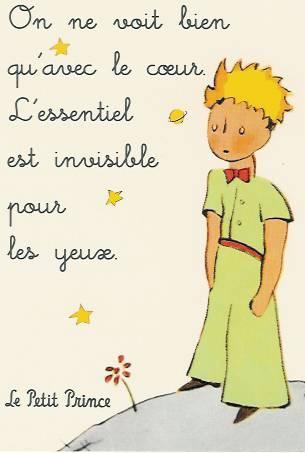
"I have measured out my life with coffee spoons"
~ T.S. Eliot
"The Love Song of J. Alfred Prufrock"

Saturday, June 21, 2014

50 years since the murders of Goodman, Chaney, and Schwerner


Scherwner, Chaney, and Goodman
murdered by the Klan 50 years ago today
Philadelphia, Mississippi


Today, June 21, marks the 50th anniversary of the murders of three civil rights workers near Philadelphia, Mississippi. James Chaney, Andrew Goodman, and Michael Schwerner were working for things as pure as voter registration. On that night they were pulled over for speeding, beaten and shot, and their bodied were not found for weeks. The movie "Mississippi Burning is based upon this history. Justice was never served. The lines between so-called "law enforcement" and the KKK were incredibly blurred. One Klansman was convicted on minor charged but it took until 2005 - THAT'S NOT EVEN 10 YEARS AGO - for a Klansman to be convicted and then of only manslaughter. Dozens got away with murder to this day.

And yet the Roberts' Court says we don't need crucial portions of the Voting Rights Act and Voter Suppression Laws sprout and grow like weeds all over the red states, Southern or not.

We cannot forget Cheney, Goodman, and Schwerner.

Schwerner and his wife Rita in their little VW Beetle coming down from NY to begin what was to be a lifetime of service. Goodman, a Queens College classmate of Paul Simon. And Chaney, black and born in Mississippi with the courage to join the Congress of Racial Equality when he was only 20. Rest in peace and never let us forget.

I'm just left sad and ashamed and afraid that history will repeat.

Monday, March 24, 2014

And Casper Makes Four


Meet Casper


That's Mr. Casper to Certain Folks!

Yesterday, Sunday, March 23rd, Casper joined my family. He now lives with me, Kia The Pyr Queen, and Readmore The Cat. And everyone has been getting along beautifully.  You may remember that when I tried to adopt German Shepherds, after a lifetime of adoring them and assuming I would have them all my life, Readmore, would hide for weeks and not come out! I love him too much for that. But the minute Kia walked into the door in 2010, Readmore was fine. He must have sensed the gentleness of the Pyr.

Casper, my new little boy, is three years old. Kia is eight, almost nine. Readmore, we do not know. All are Rescues, of course. Here is Kia. She's prettier than this, but this comes close to capturing her sweet face.

Kia, my love, and now I've made her a cougar.

So we all walked a lot yesterday afternoon and again last night. Casper stays close by. He's a snuggler, a cuddler, a Velcro dog, the Rescue tells me. So, by last night …


Casper right by me

By about 10 or 10:30, both doggies were all tired out and sleeping together:

Two Pyrs sleeping
Readmore was at home on the sofa:

What a sweet cat!
And this morning, Readmore posed as a bookend:

Bookends, like Old friends...

I wanted to get photos of the dogs out on our walks today, but Casper is learning to walk with us, and I am learning to handle two dogs. Kia is fine and perfect. But I couldn't quite get by with two dogs, two leashes, two poop bags, and my phone camera. I'll get some outdoor adventure pictures soon.

All three are sleeping now. I'd better have a cup of coffee or I will be going with them. 

Saturday, March 22, 2014

Fallen Soldiers


This is Prince, a Viet Nam soldier, killed in the war. He has been gone almost four decades, but his handler, his human, still thinks of him every day and will never forget him. He took an old picture of Prince and digitally inserted the handsome war dog into this photo of the Viet Nam Memorial in Washington, DC.

The title of this photo is "Where Is My Name?"

Indeed, where is Prince's name? Where are the names of all the dogs who were killed in action in the war in Viet Nam, many of whom took bullets that were meant for their human handlers, their best friends.

And what became of the valiant K-9 soldiers who survived? We abandoned them. We left the dogs behind in Viet Nam.

We should have brought all the survivors home. Home. Home is such a beautiful word.

The way we left those canine heroes behind is just one more huge black mark against us. We are not the good people we pretend to be. Thank God, the military is trying to keep dogs and handlers together after discharge now, but what about the broken hearts of those poor K-9 heroes who were so totally bonded to their soldiers and then abandoned in the past? I am so ashamed. And hurt.

Prince should have his name, among all the other dogs who gave their lives for their country and were killed in action in Viet Nam, engraved right there on that wall of heroes.

Teardrops fall. But they help no one.

Still, they fall.


Saturday, February 22, 2014

Evanescence "Missing"


From this child of God to Tomaso, who fails to recognize that I am a child of God whenever he chooses. I thought the Italian gentleman would be so very Christian when Francis I became Pope. Instead, he has become the academic, Italian, Joel Osteen, preaching how to make your pile bigger and bigger, with not a word about the least of these, not one action that comports with the Beatitudes. A heartbreaking development. A cruel, yes cruel, person, to me, not to everyone. But I know the side of him that the flock does not know. Sure do wish I didn't. Yes, I made huge mistakes. I was very wrong. It was not intentional. I apologized to Tomaso and to God. God forgave me. Tomaso never will.


Wednesday, February 12, 2014

Happy Birthday, Mr. Lincoln. I hope it was worth it.


Today is the 205th birthday of Abraham Lincoln, the 16th president of the United States, who began serving when he was 52 years old. He was president from March, 1861, until his death on April 15, 1865. One of the most beautiful arrangements of words in the English language is, to me, the Gettysburg Address,  a speech he delivered on November 19, 1863. The speech dedicated, even consecrated, the Soldiers' National Cemetery in Gettysburg, PA, just four months after the Union Army had defeated Confederate troops at that site. This particularly bloody battle carries the burden of its distinction of having resulted in the greatest number of casualties of any battle in the entire Civil War.

On April 9, 1865, Confederate General Robert E. Lee surrendered to U.S. General Ulysses S. Grant at Appomatox Court House, Virginia. Two days later, on April 11, Lincoln spoke at the White House, mentioning his approval of granting the former slaves' their right to vote. Already a hated figure among many Southerners, and despite the fact that the war was over and the "Union" was preserved, these words tipped the balance in the mind of at least one man in the White House audience, the actor John Wilkes Booth. Booth was a member of one of may groups of pro-Confederate conspirators, who could not accept the war's ending in their defeat or the end of the Confederate States of America, not to mention freedom for the slaves. It turned out that most of these groups were all talk, but conspiratorial talk would no longer do for Mr. Booth. He vowed that what he had just heard would be the last speech that President Abraham Lincoln would ever make. He was now ready for his group of conspirators to move ahead with their plans to harm President Lincoln, and they did so very quickly.

President and Mrs. Lincoln attended the play "Our American Cousin" at Ford's Theatre in Washington, DC, on the night of April 14, 1865, three days after Booth heard Lincoln speak and made his decision to commit murder. It was now just five days since Lee's surrender to Grant, ending the war. There at Ford's Theater, John Wilkes Booth shot Abraham Lincoln, mortally wounding him, and then fled. President Lincoln died the next day, April 15, 1865, becoming the first U.S. president to die by assassination.

Abraham Lincoln really did give his life to save this Union, which is one of the major reasons that the throwing around of the threat to secede on the part of contemporary figures in the old Confederate states angers me so much, as does the lingering of Booth's and the Confederates' racism.

Here is that most beautiful of speeches, from Gettysburg, PA:

Four score and seven years ago our fathers brought forth on this continent a new nation, conceived in liberty, and dedicated to the proposition that all men are created equal. Now we are engaged in a great civil war, testing whether that nation, or any nation, so conceived and so dedicated, can long endure. We are met on a great battlefield of that war. We have come to dedicate a portion of that field, as a final resting place for those who here gave their lives that that nation might live. It is altogether fitting and proper that we should do this.

But, in a larger sense, we can not dedicate, we can not consecrate, we can not hallow this ground. The brave men, living and dead, who struggled here, have consecrated it, far above our poor power to add or detract. The world will little note, nor long remember what we say here, but it can never forget what they did here. It is for us the living, rather, to be dedicated here to the unfinished work which they who fought here have thus far so nobly advanced. It is rather for us to be here dedicated to the great task remaining before us -- that from these honored dead we take increased devotion to that cause for which they gave the last full measure of devotion -- that we here highly resolve that these dead shall not have died in vain -- that this nation, under God, shall have a new birth of freedom -- and that government of the people, by the people, for the people, shall not perish from the earth.


And it is up to us, Mr. President, to see to it that you too have not died in vain.


Sunday, February 9, 2014

L'essentiel est invisible

From Le Petit Prince by Antoine de Saint-Exupéry

It was then that the fox appeared.
“Good morning,” said the fox.
“Good morning,” the little prince responded politely, although when he turned around he saw nothing.
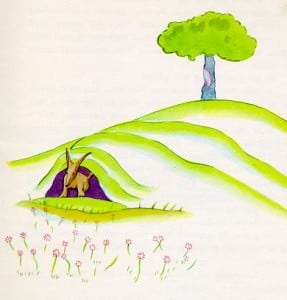
Under the Apple Tree
“I am right here,” the voice said, “under the apple tree.”
“Who are you?” asked the little prince, and added, “You are very pretty to look at.”
“I am a fox,” the fox said.
“Come and play with me,” proposed the little prince. “I am so unhappy.”
“I cannot play with you,” the fox said. “I am not tamed.”
“Ah! Please excuse me,” said the little prince.
But, after some thought, he added:
“What does that mean–’tame’?”
“You do not live here,” said the fox. “What is it that you are looking for?”
“I am looking for men,” said the little prince. “What does that mean–’tame’?”
“Men,” said the fox. “They have guns, and they hunt. It is very disturbing. They also raise chickens. These are their only interests. Are you looking for chickens?”
“No,” said the little prince. “I am looking for friends. What does that mean–’tame’?”
“It is an act too often neglected,” said the fox. It means to establish ties.”
“‘To establish ties’?”
“Just that,” said the fox. “To me, you are still nothing more than a little boy who is just like a hundred thousand other little boys. And I have no need of you. And you, on your part, have no need of me. To you, I am nothing more than a fox like a hundred thousand other foxes. But if you tame me, then we shall need each other. To me, you will be unique in all the world. To you, I shall be unique in all the world . . .”
“I am beginning to understand,” said the little prince. “There is a flower . . . I think that she has tamed me . . .”
“It is possible,” said the fox. “On the Earth one sees all sorts of things.”
“Oh, but this is not on the Earth!” said the little prince.
The fox seemed perplexed, and very curious.
“On another planet?”
“Yes.”
“Are there hunters on that planet?”
“No.”
“Ah, that is interesting! Are there chickens?”
“No.”
“Nothing is perfect,” sighed the fox.
But he came back to his idea.
“My life is very monotonous,” the fox said. “I hunt chickens; men hunt me. All the chickens are just alike, and all the men are just alike. And, in consequence, I am a little bored. But if you tame me, it will be as if the sun came to shine on my life. I shall know the sound of a step that will be different from all the others. Other steps send me hurrying back underneath the ground. Yours will call me, like music, out of my burrow. And then look: you see the grain-fields down yonder? I do not eat bread. Wheat is of no use to me. The wheat fields have nothing to say to me. And that is sad. But you have hair that is the color of gold. Think how wonderful that will be when you have tamed me! The grain, which is also golden, will bring me back the thought of you. And I shall love to listen to the wind in the wheat . . .”
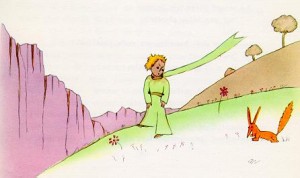
Tame me
Tame me
The fox gazed at the little prince, for a long time.
“Please–tame me!” he said.
“I want to, very much,” the little prince replied. “But I have not much time. I have friends to discover, and a great many things to understand.”
“One only understands the things that one tames,” said the fox. “Men have no more time to understand anything. They buy things all ready made at the shops. But there is no shop anywhere where one can buy friendship, and so men have no friends any more. If you want a friend, tame me . . .”
“What must I do, to tame you?” asked the little prince.
“You must be very patient,” replied the fox. “First you will sit down at a little distance from me–like that–in the grass. I shall look at you out of the corner of my eye, and you will say nothing. Words are the source of misunderstandings. But you will sit a little closer to me, every day . . .”
The next day the little prince came back.
“It would have been better to come back at the same hour,” said the fox. “If, for example, you come at four o’clock in the afternoon, then at three o’clock I shall begin to be happy. I shall feel happier and happier as the hour advances. At four o’clock, I shall already be worrying and jumping about. I shall show you how happy I am! But if you come at just any time, I shall never know at what hour my heart is to be ready to greet you . . . One must observe the proper rites . . .”
“What is a rite?” asked the little prince.
“Those also are actions too often neglected,” said the fox. “They are what make one day different from other days, one hour from other hours. There is a rite, for example, among my hunters. Every Thursday they dance with the village girls. So Thursday is a wonderful day for me! I can take a walk as far as the vineyards. But if the hunters danced at just any time, every day would be like every other day, and I should never have any vacation at all.”
So the little prince tamed the fox. And when the hour of his departure drew near–
“Ah,” said the fox, “I shall cry.”
“It is your own fault,” said the little prince. “I never wished you any sort of harm; but you wanted me to tame you . . .”
“Yes, that is so,” said the fox.
“But now you are going to cry!” said the little prince.
“Yes, that is so,” said the fox.
“Then it has done you no good at all!”
“It has done me good,” said the fox, “because of the color of the wheat fields.” And then he added:
“Go and look again at the roses. You will understand now that yours is unique in all the world. Then come back to say goodbye to me, and I will make you a present of a secret.”
The little prince went away, to look again at the roses.
“You are not at all like my rose,” he said. “As yet you are nothing. No one has tamed you, and you have tamed no one. You are like my fox when I first knew him. He was only a fox like a hundred thousand other foxes. But I have made him my friend, and now he is unique in all the world.”
And the roses were very much embarassed.
“You are beautiful, but you are empty,” he went on. “One could not die for you. To be sure, an ordinary passerby would think that my rose looked just like you–the rose that belongs to me. But in herself alone she is more important than all the hundreds of you other roses: because it is she that I have watered; because it is she that I have put under the glass globe; because it is she that I have sheltered behind the screen; because it is for her that I have killed the caterpillars (except the two or three that we saved to become butterflies); because it is she that I have listened to, when she grumbled, or boasted, or ever sometimes when she said nothing. Because she is my rose.
And he went back to meet the fox.
“And now here is my secret, a very simple secret: It is only with the heart that one can see rightly; what is essential
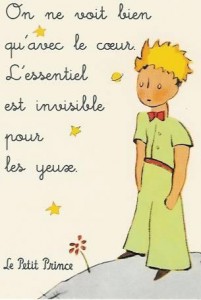
It is  The essential is invisible to the eyes
It is only wth the heart that one can can see rightly; what is essential is invisible to the eye
is  invisible to the eye.”
“What is essential is invisible to the eye,” the little prince repeated, so that he would be sure to remember.
“It is the time you have wasted for your rose that makes your rose so important.”
“It is the time I have wasted for my rose–” said the little prince, so that he would be sure to remember.
“Men have forgotten this truth,” said the fox. “But you must not forget it. You become responsible, forever, for what you have tamed. You are responsible for your rose . . .”
“I am responsible for my rose,” the little prince repeated, so that he would be sure to remember.

Saturday, February 8, 2014

Great Books Are Essential

I wrote this entry in December 2012 and kept it as an unfinished draft until today. My thoughts and feelings about the importance of including the great works of the great authors, even if we have to read Faust in translation, have not changed. If anything, I value literature more as time goes by, and I see the strength it has given me to draw on through times of sorrow and challenge and sickness as I near my own back pages.

The Telegraph's story  December 7, 2012

The UK's Telegraph is reporting that there is to be a major change in the curricula of American schools. Books like Catcher in the Rye and To Kill a Mockingbird are to be replaced by nonfiction books that will help prepare students for jobs. The Telegraph reports that at least 70% of the reading material must be nonfiction greats such as a manual for installing insulation or an inventory of plants. Apparently Great Books are now reserved for the 1%, the 99% being worker bees who don't need to clutter their heads with Miss Havisham or the great Achilles or Oedipus Rex or Don Quixote or a hundred thousand others, not all of which I've gotten to myself because there are so many. And the biggest shock of all to me is that this plan is backed by the Bill and Melinda Gates Foundation.

I learned to understand mortality from Homer's Iliad. I saw for a brief moment of flashing insight what immortality stole from the Greek gods. They squandered time on their feuds, their petty jealousies, but it didn't matter. No one was going to die. They could always make up tomorrow. But for us time is precious, people are precious, because we are mortal. I learned about the code of honor, the sacred respect for a body whose soul has passed and what a crime desecration is. I learned from Achilles the danger of unrestrained anger. I came away from Homer actually glad to be mortal. I am blessed to be mortal because I can love in a way that the Greek gods never could. And I need to appreciate the people in my life because all things must pass.

In the late 1970's I taught King Lear to a class of high school seniors who cried over how Lear was treated by his children. I was so touched that the young people felt such compassion for old Lear despite his foolishness and mistakes. There is much about madness and betrayal, but there is also the true and pure love that Cordelia feels for her father, the King. And more, always more.

These texts makes us fully human. The enhance our humanity, bring it to maturity. They teach us how others have faced the problems we face so that we know we can live through whatever we are going through. They imbue us with hope, wisdom, courage, morality, love.

And like To Kill a Mockingbird, they teach us about justice and injustice, about what other people feel, people whose shoes we will never be able to walk in, like the poor black man wrongly charged with raping a white woman and like Boo Radley, one of life's different ones. I loved Scout, her spirit, her courage, her intelligence, her gentleness. And Atticus, oh wouldn't we all want to have his courage?

And they want to replace all this with insulation manuals and plant taxonomies? And Bill and Melinda Gates are in on this. God help us all.